Showing posts with label Idiot Ego. Show all posts

12/11/2008

DOUBLE FEATURE: An Inconvenient Truth/Who Killed the Electric Car?

ARCHIVE: from Idiot Ego Issue 2 (reprinted without permission)

The ways people exchange information are changing. Just as so many Americans now rely on The Daily Show for their political coverage and other news, documentaries are becoming a serious medium by which to mass distribute important information. The Thin Blue Line helped reverse a court decision and set an innocent man out of jail. Michael Moore's Fahrenheit 9-11 broke box office records for a documentary, and Super Size Me put enough pressure on McDonald's to have them effectively phase out their upsizing campaigns. They have become an effective method of socially conscious propaganda, doubling (sometimes posing) as entertainment, and vice-versa. This is admittedly a dangerous concept, but for the moment they seem to be doing more good than harm.

Here then are two unapologetically biased, heartfelt and American documentaries pertaining to issues of the environment. An Inconvenient Truth offers a glimpse of exactly what we lost when Bush was declared winner of Florida (and subsequently won the Presidency) in 2000. His then-opponent Al Gore has a public image of being dry and humorless, but An Inconvenient Truth paints Gore as a family man, dedicated forward thinker and activist. In his way, he wants to change the world. A hero for DIY policits and reform, An Inconvenient Truth is Gore's desperate plea for Americans to stand up and take notice of global warming, because it is HAPPENING. He bombards you with the facts. They are totally stunning. Gore asks plainly, "Is it possible that America as a nation should consider addressing global threats other than terrorism?" America wanted a fighter in the White House, and they got one, but what Gore lacks in fierceness he makes up for in integrity and intelligence. Alas, these are not the kind of qualities that win elections, but forget the politics. This is a film of facts. There are lots of charts and graphs and a lot of them are glanced over rather quickly, but we never get the sense that we are being misled. If anything, An Inconvenient Truth blushes and whispers in your ear when it should probably be berating you. The cold hard indicators are the facts that Gore drops on you. They speak for themselves.

Who Killed The Electric Car? examines the birth, life, and subsequent extinction of electric cars, which were first launched by General Motors (the EV1) in 1996. They leased 800 of the cars in the 2 years that they were publicly available (there were only 1100 produced,) even with GM's weak promotion and the resulting limited consumer knowledge about the car. Those who bought the cars were later denied the option to renew their leases, and the cars were all ultimately impounded by GM and destroyed. The film largely skirts the issue that electric cars do, in fact, produce some emissions, by virtue of the coal-burning power plants which currently create more than half of America's electricity. Thus, this one is less clear cut than An Inconvenient Truth, but it is made abundantly and inarguably clear that there is more to GM's decision not to produce more EV1's than simply 'insufficient consumer demand' as they claim.

Some might label these films "progressive," and that's not such a dirty word, but the sad truth is that neither of these films by themselves will motivate the giant cogs in place in these issues to move or turn any less laboriously. It is not hard to follow the dotted lines between these two films. The reason that you cannot buy an EV1 is the same reason that global warming has systematically been "repositioned" as a debate and not a fact in the media: there is too much money at stake. It's bad for American business. You can follow that dotted line further, past these films, into the oval office and 10.000 miles over the Atlantic to the deserts and oil fields of Iraq and Kuwait, if you wish. Its not hard.

Both films promote their accompanying websites, which aim to help viewers take things to the next level, and both are equally conscious of the fact that they have essentially failed unless they are able to motivate audiences in a way that they had not been motivated before. It's great if you feel impassioned after seeing these films, but it's got to move beyond that.

If nothing else, I recommend these documentaries as superior entertainment. They are, at their core, gripping human interest stories. I hope, as the filmmakers clearly do, that they might also help to reposition the environment in your list of political agendas, and perhaps renew your faith in a country which, when operating in a bi-partisan and "progressive" way, can accomplish great things. We can't let earth die screaming. These films implore you. We have to change. How could it possibly be the wrong thing to do?

7/21/2008

Caché (Hidden)

ARCHIVE: from Idiot Ego Issue 1 (reprinted without permission)

You can only go so far when writing about a film like Caché (Hidden). Traditionally, a suspense film (a la Hitchcock, De Palma) is built mostly around a promised great "reveal," a final visual gut-punch from the screen which at last relinquishes that final crumb of information and provides the viewer with a satisfying, if often contrived, "answer." Making that compari­son, Caché's final shot has more in common with Citizen Kane than it does with Rear Window. In fact, by virtue of it's plot device, Caché comments directly on the "whodunit" genre as a whole. Austrian director Michael Haneke has built a career out of expertly subverting the preconceived notions of his audience. As a director, his skill lies in removing himself from the spotlight, and allowing his camera to observe "what is happening," rather than "what the director is showing us." His camera does not guide or force our eye, nor do his stories steer our brains. In Caché, there are trails for us to follow, but what we follow and what we dismiss along the way remains our responsibility.

Georges lives with his wife and son in a small flat in France. Someone is watching him. Someone is leaving videos of him and his family on his doorstep. Who? Why? The information on the tapes begins to suggest things. It leaves the viewer clues. Georges follows these clues. What will he find? There is a very powerful undercurrent of paranoia running throughout Caché, which gradually evolves into the film's central and unnerving theme. Scenes and events are presented ambiguously. We are very often shown an image, but given no context.. What are we looking at? Flashbacks are shot and appear almost identical to the main narrative scenes. Haneke brazenly challenges us to know the difference, to break apart from his influence as director and find our way to the conclusion ourselves. And even then, Haneke denies you the satisfaction of knowing if you are right. Caché comments grandly and with cold force on the horrifying sensation of paranoia. Is Haneke making a broader statement here? That we can't always trust the images we see on the screen? Georges seems to be very content in taking the tapes as a real document of a place and time.. And yet they remain unexplainable and mysterious. Dig deeper, into what may lie in George's subcon­scious, into what even HE may not know, and perhaps there we find a plausible solution to Caché's buried secrets.

7/07/2008

Brick

ARCHIVE: from Idiot Ego Issue 1 (reprinted without permission)

Brick is director Rian Johnson's first feature, and damnit it nearly every single frame of it isn't all his. He wrote it, shot it himself in his hometown, and cut it himself (reportedly on a home computer,) all for the price of less than a million dollars. It's a detective story; Brendan's former lover is in trouble. She calls him, frantic, looking for help. Looks like Brendan's on the case. And away we go. Consciously, and superficially, it's a genre film. A Film Noir, to be exact, and basically it's all been done before. But it's never been done like THIS before. How so? Well, because Brendan's no Humphrey Bogart. He's just a kid (albeit an unusually smart and savvy kid). The characters in Brick are all in high school. Other than that, the genre remains intact; heavies, fall guys, informants, femme fatales, and everything else you might :expect are the story's components. But Brick is not quite as by-the-numbers as it might lead you to believe. I expected he tension and the mystery. What I didn't expect was the photography, the subtle humor, and the acting. Somehow, these players keep the film's conceit believable.

It's hard to be completely comfortable watching the kid from 3rd Rock From the Sun (Joseph Gordon-Levitt) as some kind of hard-boiled teenage gumshoe on the prowl. In between the fist-fights and the phone calls, Brendan chews on lines like: "Throw one at me if you want, hash head. I've got all five senses and I slept last night, that puts me six up on the lot of you." Thus, one's enjoyment of the film hangs on the not-so-small contingent that you can put that fact aside and have fun listening anyway. Now ten years out of film school, director Johnson is poised to take a place somewhere between Richard Kelly & David Gordon Green among the new young directors making smart movies for smart young people. It's damn entertaining and intense fun, even if you can't pull down every single thick chunk of detective-speak as fast as Johnson dishes them out. Watch it twice; first for the thrill of it all, and again to let the whole thing soak in. Never mind that kid at Hollywood Video who said it's the best film of the year. Young folks are excitable. Don't watch it because you liked Donnie Darko. Watch it because you liked Chinatown.

5/20/2008

Edmond

ARCHIVE: from Idiot Ego Issue 2
(reprinted without permission)

David Mamet gets my vote for America's most undervalued dramatist (Pulitzer Prize duly noted.) Edmond is one of his earlier works, first published as a play in 1982, and it displays Mamet as his most fearless and relentless creative apex. It's intense. It makes Glengarry Glen Ross look like a Century 21 training video.

The part of Edmond belongs to William H. Macy, who studied in college under Mamet, and who has been working with him in films (State & Main, Spartan) and on the stage for more than twenty years. You can count the number of films which have given Macy top billing on one hand, an it's a shame. This is absolutely his show. The rest of the cast, including several other frequent Mamet colaborators (Joe Mantegna, Rebecca Pidgeon) and some newer faces (best credit ever: Mena Suvari as "Whore") are basically reduced to excellent background noise. It is worth noting that this is the second time in as many years that the visage of Macy's naked hindquarters has been permanently commited to celluloid. Fearless. The film is not directed by Mamet, who has directed many of his own scripts in the past, but rather by Stuart Gordon, whose work has rarely extended beyond the realm of horror (Reanimator.) Thankfully, it does not suffer for it.

Don't fool yourself; Edmond is no psychopath. I'm not even sure you can call him an anti-hero. Rather, he is a man, reacting (as he must) to the maddening binds and restriction of western civilization. He does and says some terrible things. But... for the right reasons? Mamet seems to pose the question: Who is more despicable? Those who deny themselves these type of actions under the guise of "humanity," or those who give in completely and risk letting it destroy them? Edmond is, as much of Mamet's work, a rumination on one of life's essential catch 22's: the impossibility of true freedom in a bureaucratic world. Must we be automatically dismissive of certain undeniable human and animal instincts? Right or wrong, Edmond Burke cannot do this, and he learns the rewards and consequences of relenting to the machinations of your deepest, most primal (perhaps truest?) urges and desires.

2/04/2008

INLAND EMPIRE

ARCHIVE: from Idiot Ego Issue 3
(reprinted without permission)


If you know who David Lynch is, good for you. He's pretty famous these days. Among other things, David Lynch makes movies. His most famous are Eraserhead, Blue Velvet and Mulholland Drive. INLAND EMPIRE is his newest project, but whether or not it's a "movie" is kind-of up to you. Lots of people have very specific definitions of what a "movie" is or should be. Mainstream Hollywood has made a bazillion-dollar industry out of giving people straight, uncomplicated conflicts with easy and complete resolutions so they can go home and go to bed feeling good. But Lynch is here to remind us that movies can and should have lots of different functions, and most of his best work deliberately subverts the traditional conflict/resolution narrative structure. INLAND EMPIRE takes you on a terrifying and incomparable journey, no question, but whether or not you'll go home feeling satisfied is debatable.

It's much more fun simply to think about "INLAND EMPIRE" (the title is to appear in all caps, per David Lynch) than it is to try to review it. I say "try" deliberately, because by virtue of it's lack of narrative, the film is basically review-proof. So, if Lynch isn't trying to tell us a story, what's he trying to do? You're welcome to ask him, but he'll probably only answer you with more questions. I was lucky enough to attend a screening where Mr. Lynch gave a Q & A after the film (at the Music Box Theater in Chicago) and his responses were interesting, but not necessarily "helpful." He was careful to be evasive. He wants you to figure it out for yourself.

What little storyline there is revolves around an aging Hollywood actress named Nikki, given a renewed chance at importance with a role in a new high-profile production called "On High in Blue Tomorrows." But that thread is dangled only for about 30 minutes or so, until Lynch pulls the drain plug, and things quickly get dark as we start circling the drain. This is a tough one to crack, and arguably Lynch's toughest yet. Where INLAND EMPIRE succeeds completely is as a culmination of all things Lynch, stretched out, on display, and amplified into some kind of hellish frenzy. But I can understand the argument that Lynch has let his creative fetishes get the best of him. The result of this uncompromised vision is a 3 hour movie with very little resolution, and one man's ultimate artistic achievement is another man's pretentious bullshit. Thus, INLAND EMPIRE will undoubtedly play better for most on DVD than it did the theater (It's unquestionably a lot to digest in one sitting, and I look forward to taking my future repeat viewings on the installment plan.)

The main mistake people make with Lynch's films is getting too hung up on "what it all means." INLAND EMPIRE is like an unsolvable Rubik's cube that you can twist and turn endlessly in your head, but never get right. If you don't get it, or you don't like it, I don't blame you. All I ask is that you watch it and think about it. That's what it's for. And remember, there are no stupid questions. Except maybe "what is it about??" But, if you really have to ask that one, just remember that every answer is right.

DOUBLE FEATURE - Fast Food Nation / Idiocracy

ARCHIVE: from Idiot Ego Issue 3
(reprinted without permission)


Fast Food Nation was released in theaters last November, and it was gone faster than I can suck down a triple-thick milkshake. This is understandable. It's a tough sell: a fictionalized expose of the behind-the-scenes of the fast food industry, based on a real expose (the book by Eric Schlosser of the same name.) But Fast Food Nation is really more about the nation than it is about the fast food. It's about a nation choking on it's own corporations, the people who live in that nation, and the ways in which those people are (or aren't) involved. From the immigrant workers at the meat plant, to the kids at the registers and on the grills, up to their managers, all the way to the big shots in the conference rooms who market it, and a lot of people in between. It's Mickey's Hamburgers as a metaphor for the broken American dream.

The film meanders a lot (Linklater has an affinity and talent for the "vignette" style,) and it get's a little cameo crazy (Ethan Hawke, Bruce Willis, and Avril Lavigne (?) turn up in supporting roles,) but the stories are told successfully and movingly. It's bleak, it's human, and it's probably more true than we know, but it's never preachy. Fast Food Nation doesn't tell you what to think, and it doesn't try to lay a guilt trip on you. It's every bit as interesting, thought-provoking and worthwhile as Linklater's popular Waking Life or A Scanner Darkly, but unfortunately, without the trippy animation style that helped those films pull in viewers, it will most likely remain comparatively underseen.

Now, lets flash-forward 500 years..

Idiocracy is one of the most improbable movies you will ever see. How improbable? Well, I'll tell you. The year is 2505. The world has hilariously and horrifyingly gone to shit. The water fountains all pump an energy drink called Brawndo (The Thirst Mutilator!), the top rated show on TV is called "Ow! My Balls!" and the president is a former pro wrestler and pornstar who carries a machine gun. Joe Bauers is there (Luke Wilson,) but he's from our present day. Never mind how he got there. In 2005 he was just an average, innocently likeable loser. But by 2505 standards, he's a fucking genius.


If this movie doesn't sound condescending and borderline assholish yet, I promise you it is. The title alone practically screams of self-importance and superiority. Idiocracy takes the corporate greed and lazy American complacency of Fast Food Nation and exploits it all the way to it's furthest comedic end. The movie is by Mike Judge, who made Office Space seven years ago, and has done little since except quietly sit back and watch that film mutate from a box office flop, to a hit on video, to the classic of American comedy that it is today. Idiocracy is co-written by Etan Cohen, Judge's cohort from the Beavis and Butthead days, and it shows. It often feels like an unnatural hybrid of that shows crudeness and the comparitively sophisticated humor of Office Space.

The result of this hybrid is way weird, and like I said, improbable. The direction is heavy handed, and the constant voice over is annoying and completely unnecessary. But somehow the end result is likeable, fun, and at times extremely funny. This is a movie worth seeing, and supporting. A popcorn movie for all us pseudo-intellectuals, Idiocracy lets you laugh at the shameful ignorance of this future world, while it not-so-subtly suggests that we may not be very far from it right now. Luke Wilson again demonstrates the scrutiny in choosing projects that his brother Owen lacks (see You, Me and Dupree, Night at the Museum) and Judge rewards him with an unchallenging role that he probably could have played in his sleep.

Still though, a nagging question remains: can you make a dumbed-down movie about the dumbing down of America which asks it's audience to laugh at the same dumbed-down humor that it seemingly chastises? Apparently you can, but it takes balls. From the film maker, from the viewer, and from the studio. Judge held up his end, but Fox bailed on him. The movie got shelved for almost two years, until it was finally released to a whopping 125 theaters nationwide, with no promotion and in an obviously studio-edited version (a fate all too similar to the theatrical release of Office Space, also produced by Fox.) The DVD does not include any additional footage, and Judge is conspicuously absent from the already skimpy bonus features. Thus, it's easy to see what happened here. You can only get kicked in the balls by the same people so many times before it's time to turn away from them for good. Stay away from those damned studios, Mr. Judge. They're no good for you. But keep making movies that tell us how stupid we are. Otherwise, apparently, the world is doomed.

Marie Antoinette

ARCHIVE: from Idiot Ego Issue 3
(reprinted without permission)


Montages. 80's music. Gay hairdressers. Champagne. Rip Torn gettin' on Asia Argento. Drinking. Gambling. Need I say more? If you ever thought you knew what a "period piece" was, Sofia Coppola's follow-up to Lost in Translation is here to tell you that you don't. The movie is not unlike the real Marie Antionette herself: indulgent, reckless, regal, unpretentious and somewhat immature. I didn't know much about the real story of Marie Antionette before I watched it, and I wasn't really much closer when it ended (I needed a quick brush-up on Wikipedia to set me straight.) The movie is definitely a paint-by-numbers version of her life, and it casually omits certain aspects while glossing over others.

Over the years, a lot of guys have tried to tell me that Kirsten Dunst is not hot. I beg to differ, gentlemen. There is something quite alluring about a woman in a classical French dress. The beautiful sets and costumes are really the main attraction of Marie Antionette, so much so that I wished I had seen it on the big screen. The movie was also filmed in France, in many cases in the actual palaces and gardens that once belonged to Maire Antionette. Jason Schwartzman, as Antionette's limp-dicked husband King Louie XVI, is my favorite piece of casting in a long time. I almost feel bad for him that he's so perfect in the role.

In the end, the story of Marie Antionette is a tale of vicious propaganda, basically the 18th century version of "bad publicity." Coppola's film reworks it all into terms that young people can understand and enjoy, while somehow managing to keep things believable. It's a breath of fresh air from the way a story like this would usually be filmed, and it's a gutsy and surprisingly successful experiment in putting a stylish, modern spin on a stiff old story.

Lady in the Water

ARCHIVE: from Idiot Ego Issue 3
(reprinted without permission)


I am a sucker for an M. Night Shamalan movie. Yeah, I even liked "The Village." But lately I am noticing some alarming trends, and he's starting to worry me. "Lady in the Water" is pretty much a complete failure. I liked the look of it, and the music too, but not much else. You won't find too many fans of this film.

That said, part of me wants to defend this movie. I can't help but feel that the studio system is the reason for Shamalan's declining popularity. Hollywood doesn't know how to promote a new Shamalan movie other than as a summer thrillride (Unbreakable being the only exception among his 5 films.) There is a deliberately misleading disconnect between the way that his films are advertised and what they actually are. Lady in the Water is no thrillride. It's a kid's movie, at best. With better execution, it might have found a place among classics like The Dark Crystal and The Witches as a scary/fun kids movie that adults could enjoy too. Instead, it winds up like a cross between The Neverending Story and some really lame episode of "Are You Afraid of the Dark."

I stayed away from this for a long time, and went into it once the backlash had died, content to accept it as the family oriented "bedtime story" I had heard it described as in reviews. But in viewing the film, it became evident exactly how troubling Lady in the Water is. Shamalan is trusting himself way too much, and it's hurting him. Once again he casts himself, this time in a larger role as a writer who's ideas "will change the world." He even allows a moment in the film to literally kill off a sniveling film critic character. The rest of the film is a slap-dash combination of stereotypes and bad ideas, masquerading as playful novelty.

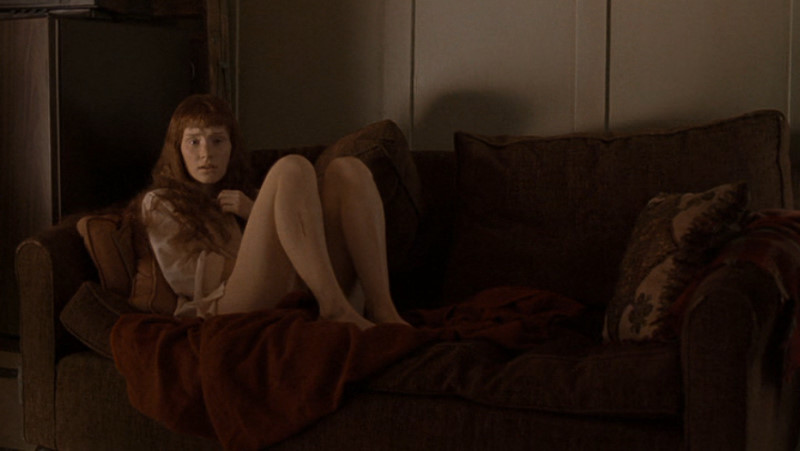
It is also somewhat troubling the way that Shamalan chooses to shoot his female lead Bryce Dallas Howard. It's all very sensual. She's supposed to be a force for good in the movie, and I found myself wishing that Shamalan would cut away from Paul Giamatti as a voyeur, trying not to look when "Story," this other-worldly young Narf, whom he observes as being "just a kid" (Howard is 25, but still..) naively slips off her clothes in his apartment. Too many lingering shots of wet and naked appendages.

If Shamalan wants to be Hitchcock so bad, he needs to think of himself more as a craftsman and less as an autuer. He needs to stop giving into these terrible impulses. Maybe start working with smaller budgets. Maybe direct a script or two that he didn't write. Maybe stay behind the camera. I don't blame him for not wanting to make the same movie over and over again, but there are better ways of experimenting than just throwing things at the wall, seeing what sticks, and then dumping it into theaters. He has produced two major box office failures in a row, and I don't think he has any more second chances to play with. I still have a shitload of faith in Shamalan as a film maker. His skills and his influences are on the right place. His heart is too, but he lets it get the best of him. This is his weakest effort. Lady in the Water is completely fucking ridiculous. He's young, guys. He'll learn.. I hope.